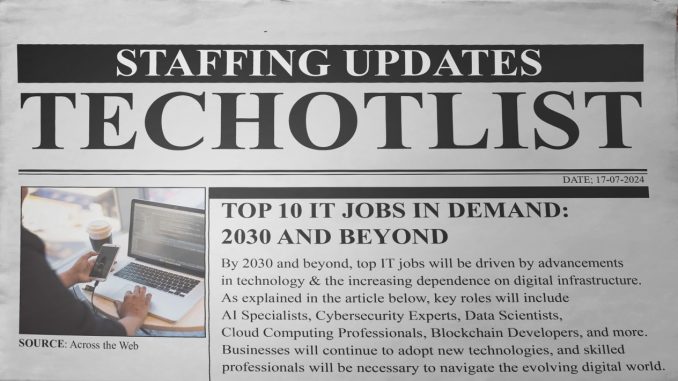
The pace of technological change has always shaped the job market, and looking ahead to 2030, it is clear that the next wave of transformation will demand entirely new skill sets while reshaping traditional roles. As artificial intelligence, automation, cybersecurity, and sustainability converge with global economic needs, certain tech jobs will become critical not only for businesses but for society as a whole. For professionals considering where to invest their time and education, understanding which roles are likely to grow offers both direction and opportunity.
Artificial intelligence and machine learning will continue to dominate demand, but the roles within these areas will become more specialized. By 2030, companies will require experts who can not only build and train models but also ensure that AI systems are ethical, transparent, and explainable. The focus will shift from just creating powerful algorithms to designing systems that are trusted and accountable. For instance, healthcare providers using AI for diagnostics will need professionals who can validate the fairness of predictions and ensure compliance with regulations. This creates demand for AI ethicists, model auditors, and specialists in responsible AI, roles that barely existed a decade ago but are quickly becoming essential.
Cybersecurity is another field expected to expand dramatically. As more of the world’s critical infrastructure—from energy grids to financial systems—relies on digital platforms, the stakes for security will only rise. By 2030, cybersecurity professionals will need to defend against increasingly sophisticated threats, including those fueled by AI-driven attacks. Roles such as security analysts, penetration testers, and digital forensics experts will remain central, but there will also be a surge in demand for specialists in securing the Internet of Things and protecting cloud-based systems. Imagine a world where billions of connected devices—from smart homes to autonomous vehicles—require constant monitoring; the professionals who can safeguard these ecosystems will be indispensable.
The rise of automation and robotics will also shape the labor market. While some fear that robots will take jobs, the reality is that new opportunities will emerge in designing, maintaining, and improving automated systems. By 2030, robotics engineers and automation architects will be in high demand across industries like manufacturing, logistics, and healthcare. Hospitals may rely on robotic assistants for surgeries or patient care, while warehouses will continue to expand fleets of automated machines for handling goods. Each of these scenarios requires skilled professionals who can integrate robotics into workflows, troubleshoot problems, and ensure efficiency. These jobs highlight how automation is less about replacement and more about partnership between humans and machines.
Sustainability and green technology are also poised to create entirely new categories of tech jobs. As governments and corporations pursue aggressive climate goals, there will be a surge in demand for experts who can design and manage clean energy systems, smart grids, and sustainable supply chains. Data analysts focused on environmental impact, engineers who can optimize renewable energy storage, and specialists in carbon-tracking technologies will be critical. For businesses, this is not just about compliance but about long-term competitiveness, as consumers and investors increasingly reward companies that prioritize sustainability. By 2030, the tech workforce will need to integrate environmental considerations into everything from product design to infrastructure planning.
Biotechnology and digital health represent another frontier where tech jobs will flourish. Advances in genomics, wearable health devices, and personalized medicine are creating vast amounts of data that require specialized analysis. Bioinformatics experts, health data scientists, and digital health engineers will be essential for turning this information into actionable insights. The COVID-19 pandemic accelerated investment in digital health, and that momentum is unlikely to slow. By 2030, patients may rely on AI-driven health platforms that continuously monitor vital signs and suggest interventions, all of which will need teams of tech professionals to design, manage, and regulate.
The growing integration of immersive technologies such as augmented reality and virtual reality will also shape new career paths. By 2030, AR and VR are expected to be standard tools in industries like education, training, retail, and real estate. This will drive demand for AR/VR developers, user experience designers, and content creators who can build environments that are both functional and engaging. Imagine workplace training programs where employees learn through simulated environments tailored to their tasks; professionals who can design and manage these platforms will play a crucial role in the workforce of the future.
Underlying all these changes is the increasing importance of data. By 2030, data scientists, engineers, and analysts will remain among the most sought-after professionals, but their roles will continue to evolve. It will no longer be enough to simply collect and analyze data; the challenge will be making sense of it in ways that drive ethical, strategic decisions. This means professionals who can combine technical expertise with business acumen will be especially valuable. For example, a retail company may not only want to understand customer preferences but also how to align its operations with sustainability goals, requiring data professionals who can connect dots across disciplines.
What unites these in-demand roles is the need for adaptability and interdisciplinary skills. The jobs of 2030 will not belong solely to technologists who can code or configure systems. They will require professionals who understand the human, ethical, and business contexts in which technology operates. Collaboration will be as important as technical skill, as teams increasingly span multiple specialties and geographies. The best-prepared workers will be those who combine deep expertise in one area with the flexibility to learn and adapt as technology evolves.
Ultimately, the tech jobs that will be in demand by 2030 reflect the broader priorities of society. As we look toward a future shaped by AI, automation, cybersecurity, sustainability, and health, the roles that emerge will be those that help us navigate both opportunity and risk. For individuals, this means that investing in skills now—whether in data science, ethical AI, or green technology—can provide a path to resilience in an uncertain job market. For businesses, it highlights the need to cultivate talent pipelines that are ready for the next decade’s challenges. The future of work will not be defined by technology alone but by the people who understand how to harness it responsibly and effectively.